

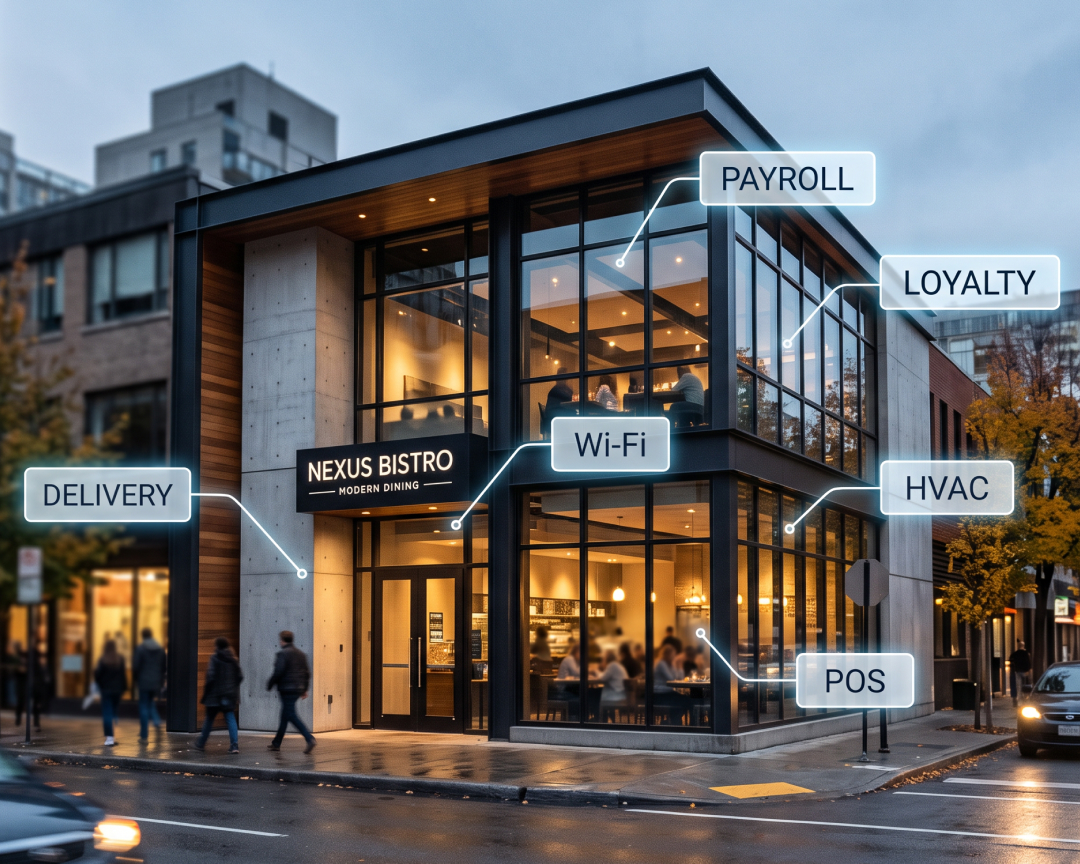
When a guest connects to your hotel Wi-Fi, a payment processes at the front desk, lunch rings through a restaurant point-of-sale (POS) system, and a manager pulls up reservations. That isn’t four separate systems. It’s one converged network that has at least four ways in.
For hospitality operators managing single properties or portfolios across multiple brands, this convergence defines the security challenge. Guest Wi-Fi, payment systems, reservation databases, and building Internet of Things (IoT) devices run on shared infrastructure, often monitored by lean IT teams stretched across dozens of locations. A breach rarely stays isolated; it spreads through the seams where defenses are weakest.
In this article, we walk through why hospitality's converged environment demands unified detection and response, why segmenting guest Wi-Fi alone isn't enough, and how to evaluate Managed Detection & Response (MDR) built for multi-property operators.
What is the hospitality attack surface?
The hospitality attack surface is the full set of connected systems that process guest and payment data across a property: the Property Management System (PMS), POS outlets, guest Wi-Fi, staff networks, building IoT, and third-party integrations. Because these systems increasingly run on shared infrastructure, a weakness in one becomes a path into the others.
The Property Management System (PMS) is the central hub, housing reservations, payment cards, guest names, IDs, passport data, loyalty accounts, and stay patterns, all of which are exposed at once when it's breached.
POS systems at restaurants, spas, retail, and valet all process payment cards, and a restaurant inside a hotel typically runs on the same network as guest Wi-Fi, so segmentation assumptions often fail in practice.
Guest Wi-Fi is both a brand promise and a persistent attack vector: guest devices are untrusted by definition, yet they connect to infrastructure controlling access to operational systems.
Staff networks carry turnover risk, since departing employees and seasonal workers retain credentials mapped to guest data.
Building IoT, including door locks, HVAC, and cameras with minimal hardening, and third-party integrations for booking, payments, and loyalty add supply-chain risk.
Treating each system as its own problem creates a false sense of protection. Attackers move through the gaps between them, where visibility ends and responsibility blurs.
Why are hotels and restaurants targeted, and why does detection take so long?
Hotels and restaurants are targeted because they concentrate high-value guest data on lean, fragmented IT teams. Detection lags because the data moves across separate systems (guest Wi-Fi, PMS, POS, and payment), each monitored on its own, so no single view sees an attack move from one to the next.
Verizon's 2024 Data Breach Investigations Report names stolen credentials as the most common way attackers get in, present in nearly a quarter of all breaches, with 77% of web-application attacks relying on them. Guest data is what makes hospitality worth that effort: payment cards, IDs, travel itineraries, and loyalty credentials all sit in one target. Round-the-clock operations give attackers time to hide activity in normal traffic, and high staff turnover keeps a steady supply of reusable credentials in circulation.
Organizational fragmentation compounds the exposure. Brands set standards, management companies operate multiple flags, property IT managers execute, and owners and operators split costs. When monitoring gaps emerge, no single stakeholder owns closing them.
Detection windows are also long. An attack can begin in guest Wi-Fi, move laterally into the PMS, then target payment systems, with separate monitoring at each stage and no unified view of the progression. IBM's 2026 Cost of a Data Breach Report puts the global average detection-and-containment window at 247 days, more than eight months and the first increase after five straight years of decline. Longer detection times mean greater data exposure, higher recovery costs, and reputational damage across the portfolio.
Is it enough to put guest Wi-Fi on a separate network?
No. Separating guest Wi-Fi from operational systems is necessary, but segmentation alone doesn't stop attackers. It prevents guest devices from directly accessing operational data, yet it leaves several paths open, and it only holds if every property is perfectly configured.
Segmentation does not prevent:
- Footholds and pivots. Attackers use guest Wi-Fi to probe operational network weaknesses or infect guest devices with malware and turn them against your infrastructure. Booking and loyalty platforms that span both networks create additional lateral movement pathways.
- Traffic interception. Guests check email, log in to bank accounts, and connect to corporate VPNs, and weak encryption exposes those credentials to capture.
Segmentation also demands perfect consistency across every property; a single misconfigured access point or drifted firewall rule can expose your entire brand.
The real question is not "Is guest Wi-Fi separated?" It's "Can we detect threats on guest Wi-Fi in real time and correlate them with operational indicators across all properties?"
What should a hospitality security program include?
A hospitality security program should include unified visibility across every system and property, converged detection that follows threats between systems, response that doesn't take operations offline, compliance reporting mapped to brand and PCI requirements, and centralized expertise. PCI DSS v4.0 sets the floor, not the ceiling.
The PCI DSS v4.0 requirements became mandatory on March 31, 2025, tightening controls on payment page scripts, multi-factor authentication, and anti-phishing measures. We cover the standard in depth in our PCI DSS compliance guide, and we’ve written separately on why compliance alone no longer equals security for multi-location businesses. Meeting the standard proves you handle cardholder data responsibly. It doesn't prove you'd catch an attacker moving through your network at 2 a.m. Protection of guest data isn't a compliance checkbox. It's the core business objective.
What is MDR, and why does hospitality need a version built for it?
Managed Detection & Response (MDR) combines continuous monitoring, threat detection, and expert-led response across your environment. Hospitality needs a purpose-built version because generic enterprise MDR doesn't account for converged property networks, mixed-brand technology stacks, or 24-hour operations that can't be taken offline.
We explain how MDR works, what it includes, and how it compares to other approaches in our guides to what MDR is and its key benefits. What matters in hospitality is that your threat detection and response function normalizes data from diverse PMS platforms, POS systems, networks, and building systems into a single view, and it catches lateral movement between guest Wi-Fi and operational networks before attackers complete data theft.
MDR also contains threats without taking systems offline, because hospitality operations can’t pause; guests are in their rooms and payments must keep processing. And through the Asgard Platform®, it automatically maps per-property events to brand standards and compliance frameworks rather than leaving you to reconcile fragmented logs. That last point matters most for operators facing what we've called the franchise uptime paradox, where one location's incident becomes every location's problem.
How do you evaluate MDR for a hospitality business?
The general questions to ask any MDR provider, including coverage, response times, and pricing model, apply here too, and we walk through those in our comparison of MDR versus XDR. For hospitality, the deciding factor is whether a solution is built for converged, multi-property environments or is retrofitting an enterprise product. Press vendors on six points: coverage of every PMS, POS, booking engine, and loyalty platform in your portfolio; the specific attack patterns detected on guest Wi-Fi and how fast; whether a threat at one property surfaces automatically in a single dashboard; mean time to respond and 24x7 coverage that doesn't disrupt guests; automatic per-property reporting mapped to PCI DSS; and the size of the hospitality portfolios they already run. Vendors offering only network monitoring rather than behavioral detection, or lacking multi-property experience, haven't been built for hospitality.
How does faster detection protect guest trust?
Faster detection protects guest trust by containing a breach before it spreads across systems and properties. The sooner an attack is caught, the fewer guests are exposed, the lower the fraud and notification costs, and the less damage to the brand.
A payment card breach triggers notification obligations, fraud liability, and reputational damage. Those notification requirements apply in every state where affected guests live, not just where your property is located.
Credential-based attacks are the hardest to catch because attackers use stolen passwords to access the PMS like normal staff, running role-appropriate queries that look unremarkable in isolated logs. Unified MDR catches what fragmented tools miss. A login from an unfamiliar location, followed by unusually broad queries, followed by access to data exports, forms one composite pattern. Separate systems see three benign events; unified monitoring sees one suspicious progression.
How do you know if your current security is enough?
A few honest questions reveal where you stand. If you can't answer them clearly, you probably have gaps worth closing.
Can your team view guest Wi-Fi, POS, PMS, and staff networks in one dashboard, or are those views scattered? If attackers moved from guest Wi-Fi into your PMS, would you detect it in hours or days? Does monitoring run around the clock, or stop after business hours? Is coverage consistent across every property? And do a handful of IT generalists cover multiple properties without specialized security capability? A gap in any of these is a reason to evaluate hospitality MDR.
What should you do now?
Start with three steps, then avoid three common mistakes.
Verify that guest Wi-Fi is truly segmented from PMS and POS at each property; inventory every system that accesses payment card data or guest personally identifiable information (PII), including booking engines and loyalty platforms; and confirm that overnight and weekend monitoring is in place. The mistakes: assuming brand-mandated tools equal monitored security, leaving food, beverage, or amenity outlets out of scope when they share the same network, and treating guest Wi-Fi security as a one-time project when configuration drift is constant.
How VikingCloud supports hospitality security.
Protecting a converged, multi-property environment is demanding, and most operators don't have the internal resources to monitor every system 24x7 continuously. That's where a managed partner makes the difference.
VikingCloud delivers Managed Security Services (MSS), including Managed Detection & Response (MDR), built for multi-location operators managing portfolios that mix hotels, restaurants, bars, spas, and retail on shared infrastructure. Our hospitality practice pairs portfolio-wide visibility through the Asgard Platform with 24x7 global expert response from teams that know hospitality's networks, compliance frameworks, and operational constraints.
VikingCloud is trusted by 4+ million business locations in 70+ countries, with 98% customer retention. We keep guest data protected, systems running, and brand reputation intact across your portfolio. Contact us to learn more about how we can support your hospitality security needs.
FAQs
What is MDR in hospitality?
Managed Detection & Response (MDR) in hospitality is a managed service that continuously monitors a property's connected systems (guest Wi-Fi, POS, PMS, staff networks, and building IoT), detects threats across them, and provides expert-led response without interrupting 24-hour operations.
Is hotel Wi-Fi secure?
Hotel Wi-Fi is only as secure as its configuration and monitoring. Even when guest Wi-Fi is segmented from operational systems, attackers can use it to probe the network, intercept unencrypted traffic, or pivot from compromised guest devices. Segmentation reduces risk but doesn't eliminate it without active detection.
How do I secure guest Wi-Fi across multiple properties?
Segment guest Wi-Fi from PMS and POS at every location, then keep access-point and firewall configurations identical across the portfolio; inconsistency between properties is where most exposure hides. Add continuous monitoring that correlates guest-network activity with your operational systems, so a threat on one property's Wi-Fi is visible centrally rather than buried in a local log.
Does PCI DSS v4.0 apply to hotels and restaurants?
Yes. Any organization that stores, processes, or transmits payment card data must comply with PCI DSS v4.0, which became mandatory on March 31, 2025. In hospitality, that scope includes the PMS, every POS outlet, booking engines, and any system that touches cardholder data.
What systems does hospitality MDR monitor?
Purpose-built hospitality MDR monitors the Property Management System (PMS), POS outlets, guest and staff Wi-Fi, back-office networks, building IoT such as door locks and cameras, and third-party integrations for booking, payments, and loyalty, correlating activity across all of them in a single view.


Related Blogs
Stay up-to-date on the latest happenings in Cybersecurity and PCI Compliance.
Third-Party Vendors Already Have Access to Your Stores. Are You Managing the Risk?


.png)
