

Franchising was designed to scale ownership. It was never designed to scale technology.
Your system may run hundreds or even thousands of locations under a shared brand, each with its own mix of networks, connectivity providers, point-of-sale systems, and daily operations.
Legally, those locations are separate businesses. To customers, that distinction doesn't exist.
When payment systems fail, guest Wi-Fi drops, ransomware hits, or one of your locations gets breached, the public sees one brand—not hundreds of independently owned businesses.
That gap defines franchising. You carry the most reputational exposure and the least direct control over the technology creating it. Your franchisees run the tech. You own the reputation.
The Franchise Model Creates a Visibility Challenge
The franchise business model balances consistency and independence.
According to the International Franchise Association, franchising remains one of the most successful models for scaling businesses while maintaining local ownership and operations.
You set brand standards, customer experience expectations, approved systems, and operating procedures. Your franchisees own and operate individual locations as independent businesses. That structure is built for growth.
Technology is where it gets complicated.
Over time, your system accumulates a patchwork of technology environments. Different internet providers, Wi-Fi configurations, service providers, hardware refresh schedules, and levels of maturity pile up across the network.
The bigger your system gets, the harder it is to see what’s actually happening across it.
You know how your locations should operate. That's not the same as knowing how each one actually does.
And this isn't only a security issue. Network outages, payment failures, connectivity drops, and performance problems all hit revenue, customer experience, and uptime long before they ever become security incidents.
So the real question is blunt: can you manage what you can't consistently see?
Why Franchise Locations Become Operational Risk Multipliers
Technology challenges in franchise systems rarely stay isolated. A connectivity glitch at one location looks minor until it kills transactions during the lunch rush. A payment outage starts with one franchisee until customers start posting about it. A ransomware hit lands on one operator until reporters put the corporate name in the headline.
The public doesn't distinguish between the franchisee and the franchisor. They tie the experience to the building's logo.
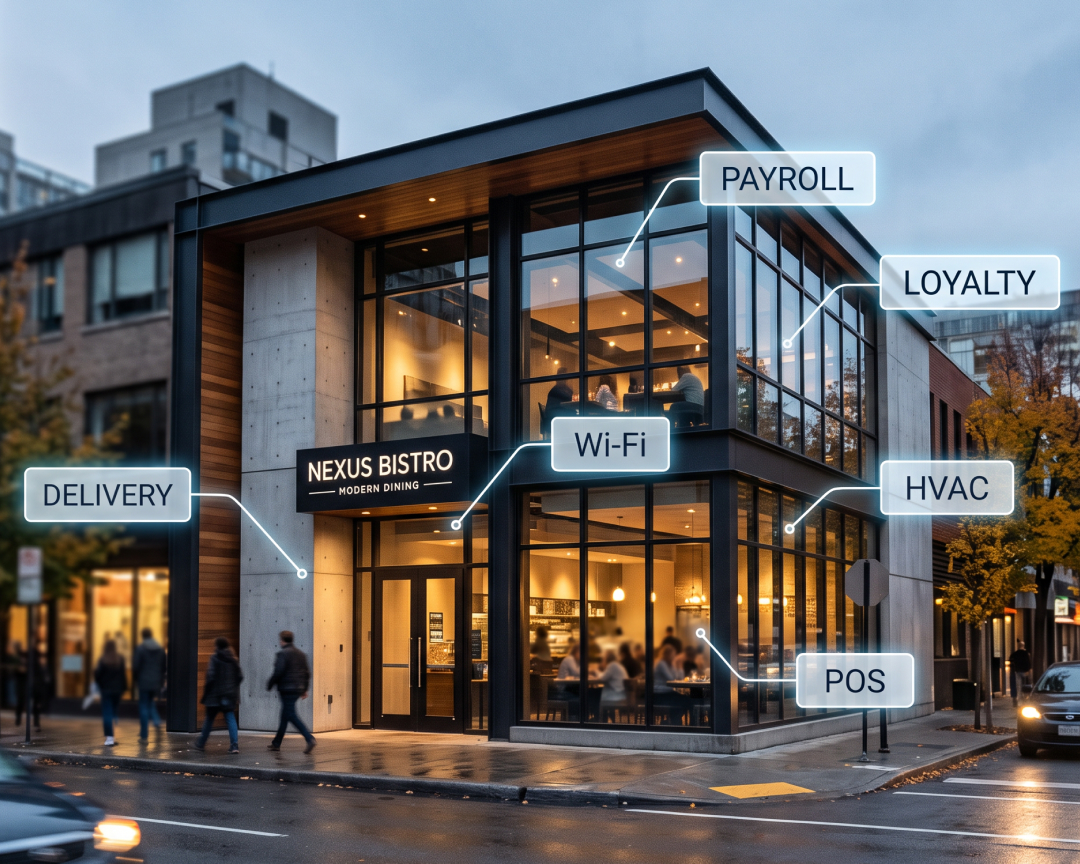
This challenge becomes even more significant in industries such as restaurants, hospitality, retail, fitness, and healthcare, where technology now runs daily operations. Point-of-sale systems, loyalty platforms, online ordering, guest Wi-Fi, mobile apps, payment environments, and third-party integrations all create dependencies that didn’t exist a decade ago.
According to the IBM Cost of a Data Breach Report, organizations continue to face substantial financial consequences when security incidents disrupt business operations. Similarly, the Verizon Data Breach Investigations Report consistently shows attackers targeting industries that rely heavily on distributed technology environments and third-party service providers.
The more your locations depend on technology, the less you can treat uptime, security, and compliance as separate problems.
Your Franchisees Are Independent Business Owners, and They’re Carrying This Alone
Here's the part that's easy to miss from the outside. Each franchise location may look like part of a big corporate system, but each one is an independent business—an SMB run by an owner already stretched across staffing, inventory, customers, and payroll. Cybersecurity lands on top of all of it. And most franchisees are handling cyber defense on their own. In our 2026 SMB Threat Landscape Report, 84% of owners said they self-manage cybersecurity, and 28% admitted the person responsible isn't properly trained.
That do-it-yourself approach carries a cost, and it isn't only technical. Two-thirds of SMB owners told us they routinely give up nights and weekends to keep up with security. More than half say security demands have made them delay or walk away from growth opportunities. The work of protecting the business is crowding out the work of running and growing it.
Doing less doesn't help either. Under-protected operators are the ones attackers hit first, and 40% of SMBs say an attack of $100,000 or less would close them for good.
So your franchisees are stuck in their own paradox. The more cybersecurity they take on themselves, the less time and focus they have to grow. The less they take it on, the more exposed they are, which also threatens growth. Either road slows down the locations your brand is counting on for revenue growth.
There's one way out of that loop: security that works out of the box, that the operator never has to learn, run, or worry about. Cybersecurity that simply works.
Why Most Mandates Fail, and the One That Doesn’t Fail, and the One That Doesn’t
The instinct to standardize everything is right. The usual execution is what fails.
Handing each franchisee a security stack to go buy and run on its own fails every time. You'll meet resistance from operators with existing vendors, who have no appetite for another requirement, and few brands want to police a firewall setting across a thousand locations. Franchise agreements, advisory councils, and legal exposure only further narrow the room.
The mandate that works looks nothing like that. You don’t ask franchisees to comply. You own the security layer and run it centrally across every location. The standard stops being a rule that each operator must meet and becomes a service that every location already offers. Nothing to buy, nothing to configure, nothing to enforce.
That's the easiest way to manage risk across a franchise system, and it's the only version of a mandate that holds. You treat security the way you treat food safety, guest experience, and brand presentation: a corporate standard, owned and delivered from the top, not a suggestion left to each location.
What a Strong Franchise Network Actually Does
The best franchise technology programs share a handful of traits.
First, technology standards are brand standards. Connectivity, network reliability, payment system availability, and security controls are operational requirements, not optional IT line items.
Second, corporate sets one approved standard and applies it the same way everywhere. One configuration, fewer gaps, no location left to improvise.
Third, baseline services cover the whole network. Managed firewalls, connectivity, guest Wi-Fi monitoring, network monitoring, and detection and response provide consistency across locations without forcing each franchisee to build its own IT bench. That matters most for smaller operators with no dedicated security staff.
Fourth, visibility is centralized. You don't have to run every location. You do need to see them all. Without that, problems stay hidden until a customer finds them first.
Fifth, compliance lives inside the bigger picture. PCI DSS still matters, especially for payment environments. But compliance works best built into a managed network, and a continuity strategy that demands control is proven effective, not run as a standalone box-check that only checks it should work.
Operational Continuity Is the New Franchise Standard
The strongest franchise systems now look at technology differently. Connectivity, security, compliance, and network management aren't separate projects anymore. They're continuity functions.
That maps to the NIST Cybersecurity Framework 2.0, built around six functions: Govern, Identify, Protect, Detect, Respond, and Recover. Govern was added in version 2.0 and sits above the other five.
The goal isn't only to stop breaches. It's to keep locations open, connected, and able to serve customers.
That changes the buying question. Not "does this improve security," but "does this keep locations running?" Not "does this generate alerts" but "does this prevent disruption?" Not "does this check a compliance box" but "does this hold the experience steady across every location?"
How Much Visibility Do You Really Have Across Your Franchise Network?
You can probably tell me exactly how many locations you run. Far harder: which ones have a connectivity problem, a compliance gap, or a network vulnerability right now?
As you add locations, holding visibility, uptime, and consistency across hundreds or thousands of independently operated sites only gets harder. The fix isn't more rules for your operators. It's a single security standard you own at corporate and run across every location.
That's what VikingCloud delivers: one managed security and connectivity program, set at the corporate level and deployed across the full network. Managed firewalls, managed connectivity, guest Wi-Fi, backup failover internet, compliance support, and centralized visibility. Your operators don't buy, build, or maintain it. You set the standard. We run it everywhere.
If you're trying to ensure continuity across your system, start by deciding what you want to hold true at every location. Then let VikingCloud make it true, without piling complexity onto your operators.


Related Blogs
Stay up-to-date on the latest happenings in Cybersecurity and PCI Compliance.


Third-Party Vendors Already Have Access to Your Stores. Are You Managing the Risk?
.png)
