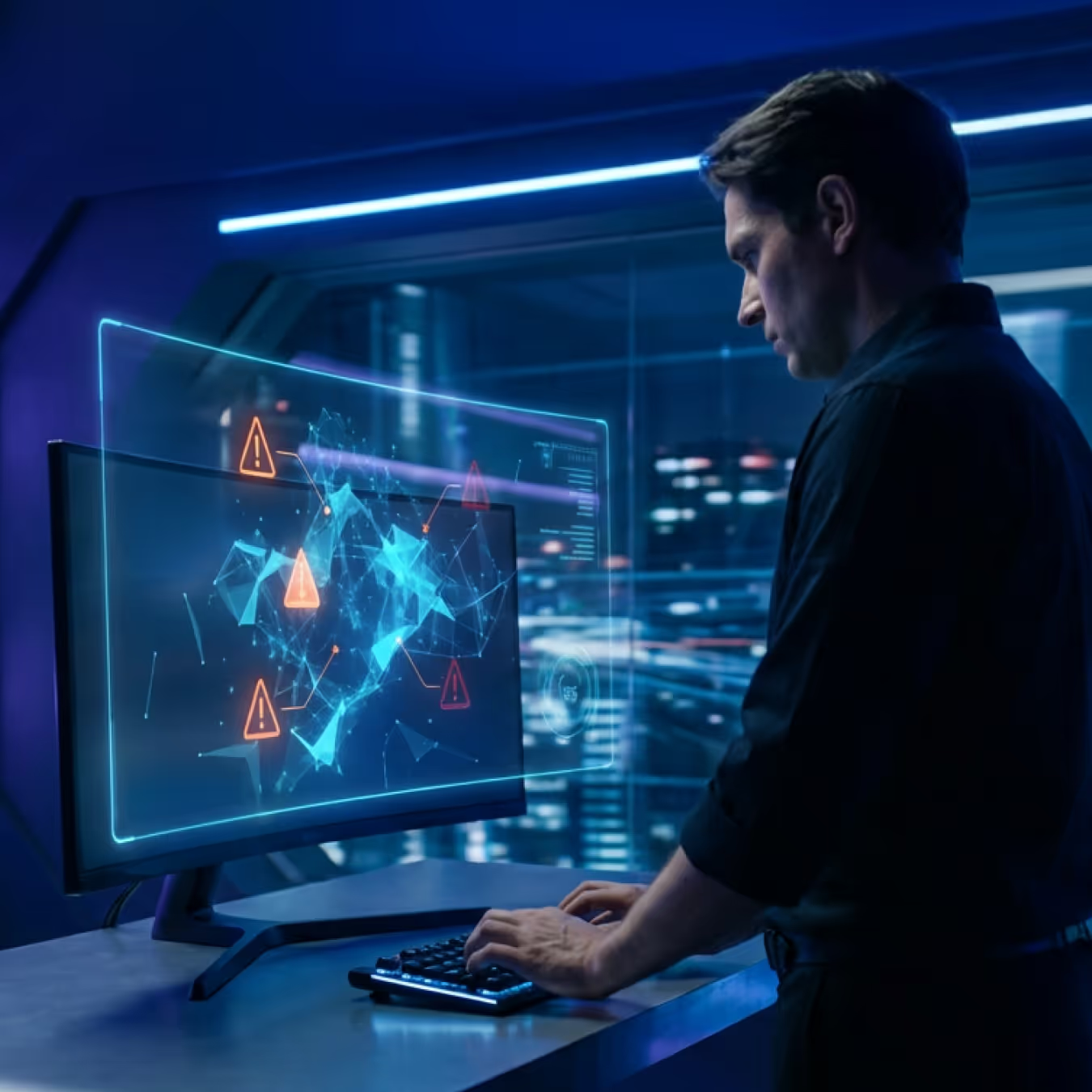
Many CISOs and security leaders, in the wake of booming interest in generative AI, ask: Will AI replace cybersecurity analysts entirely? The answer is a resounding not yet—and likely not ever. AI undeniably boosts speed and scale, but true security requires nuance, judgment, and intent—qualities that remain distinctly human. For modern security operation centers (SOCs), the future lies in augmentation, not automation; in human–AI co‑teaming, not replacement.
The Limits of Automation: Why Creative Judgment Still Matters
AI systems excel at pattern detection and surface-level anomaly spotting, yet they lack the ability to simulate cunning adversaries, full context, or creativity. A recent Microsoft Research study revealed that over-reliance on generative AI tools can erode critical thinking among knowledge workers—paralleling how GPS can diminish our navigational instincts.
Moreover, defenders are constantly challenged by zero-day threats—attacks unknown to history and unseen by training data. In such cases, only human intuition, skepticism, and experience can bridge the gaps. Analysts also bring emotional intelligence, contextual understanding, and ethical discretion—traits that can’t be trained into a model. It’s this creative judgment that makes the difference between simply detecting an anomaly and truly understanding a threat’s intent and impact.
Human–AI Co‑Teaming in the Modern SOC
Rather than replacing analysts, cutting-edge models envision a co‑teaming paradigm. A 2025 research paper outlines how large language model (LLM) powered AI agents learn tacit knowledge from analysts to improve alert triage, vulnerability scanning, and incident response within SOCs. AI in cybersecurity is increasingly focused on supporting analysts throughout the entire threat lifecycle—from identifying weaknesses to responding to active incidents.
Similarly, hybrid approaches are gaining traction. Industry observers note that Gartner predicts 75% of SOCs will deploy AI agents by 2026—but under a co‑teaming model, rather than full automation. Essentially, AI handles scale; humans anchor context. This collaboration allows security teams to move faster without sacrificing judgment. Analysts guide the AI, refine its assumptions, and ensure outputs are aligned with business risk and mission priorities. It’s not man versus machine—it’s man with machine, on mission.
Why False Positives and Novel Threats Still Demand a Human Touch
The high cost of false positives isn’t just hypothetical—it’s a strategic liability. A Netcraft report found that 72% of security professionals say false positives degrade productivity, while 33% of organizations are delayed in responding to real attacks because of them. Excessive noise can lead to alert fatigue, burnout, and a decline in trust in security teams.
Although AI can help filter noise, the final judgment call must lie with humans. Only through human-in-the-loop systems that continuously learn from mistakes can performance improve meaningfully. Human analysts are uniquely equipped to detect subtle anomalies, contextual mismatches, and attacker intent—especially when adversaries deliberately manipulate signals to appear benign. In this landscape, discernment is as important as detection.
Evolving Roles of Analysts: From Triage to Strategy
With AI handling routine triage, analysts are being freed for strategic tasks. A recent study underscores that while general analysis evolves, human intervention remains indispensable for interpretation, modeling intent, and escalation decision‑making.
Analysts are no longer buried in alerts—they’re guiding playbooks, managing threat intel workflows, and designing SOC policy frameworks. They’re becoming team orchestrators—governing AI outputs, modeling threats, enforcing policies, and guiding strategic defensive posture. This shift reflects a broader transformation: security professionals are being recast as AI governors, compliance stewards, and incident strategists. AI isn’t replacing jobs; it’s elevating them.
Governance, Bias & Explainability: Why Humans Stay in the Loop
Enterprise and regulatory frameworks demand accountability. Human oversight ensures decisions are transparent, explainable, and auditable. As AI complexity grows, maintaining trust in decisions becomes increasingly challenging. The “AI trust paradox” explains how increasingly human‑like AI can elicit misplaced confidence in output—making oversight essential.
Additionally, model misalignment can introduce dangerous behaviors—even from benign prompts. Governance safeguards are vital. Without explainability, security teams can’t justify actions in audits or investigations. Worse still, opaque models can perpetuate bias, make inconsistent decisions, or ignore ethical red lines. Analysts serve as a fail-safe—ensuring AI operates within defined policy, legal, and moral boundaries. Trustworthy AI starts with trustworthy humans.
How Attackers Use AI And Why It Demands More Human Oversight
Cybercriminals are not just experimenting with AI—they’re weaponizing it. As organizations deploy generative AI for defense, attackers are deploying comparable tools to amplify, personalize, and automate attacks in frighteningly effective ways.
WormGPT, for instance, has emerged as a black hat LLM designed specifically for malicious use. Without the safeguards of commercial models, it automates the writing of highly convincing phishing emails and business email compromise attacks. Even cybercriminals with limited technical skill can access it, erasing previous barriers to entry for sophisticated attacks.
AI doesn’t stop at email—it’s also infiltrating other scam vectors. At the 2025 Global Anti‑Scam Alliance conference, fraud experts highlighted how AI-driven deepfake phone and video calls are now being used to impersonate executives and manipulate victims into making wire transfers or compromising sensitive data. One notable case involved a Hong Kong finance worker who transferred HK$200 million (~ $25 million) after seeing and hearing a deepfake version of a senior executive on a video call. These hyper-realistic forgeries are no longer rare—they’re rapidly increasing.
A Wired report from mid‑2025 tallied the proliferation of deepfake scams: what was once four or five incidents per month has exploded into hundreds in just a matter of months, spanning romance fraud, employment scams, and executive impersonation. Detection tools still lag behind, meaning that human skepticism and vigilance remain the most reliable defense.
Put simply: as attackers become artificially intelligent, defenders must become more human.
VikingCloud’s Approach: AI‑Enhanced Security with Human Oversight
At VikingCloud, we're taking a deliberate approach to AI integration that prioritizes proven results over hype.
We're actively evaluating and piloting emerging AI capabilities while maintaining what we know works: expert human analysis, battle-tested detection logic, and transparent decision-making. As AI technologies mature and demonstrate clear value, we’ll integrate them into the Asgard Platform® selectively to enhance the human expertise our clients rely on.
No, AI isn’t about to eliminate cybersecurity analysts. Rather, it’s enabling them to rise above the routine, think more strategically, govern more precisely, and defend more proactively. In modern SOCs, AI serves as an ally, working in conjunction with human intelligence and judgment to counter adversaries.
Want to discuss how we’re balancing AI innovation with proven security practices? Explore our Asgard Platform and contact a VikingCloud expert.




Related Blogs
Stay up-to-date on the latest happenings in Cybersecurity and PCI Compliance.

.png)