

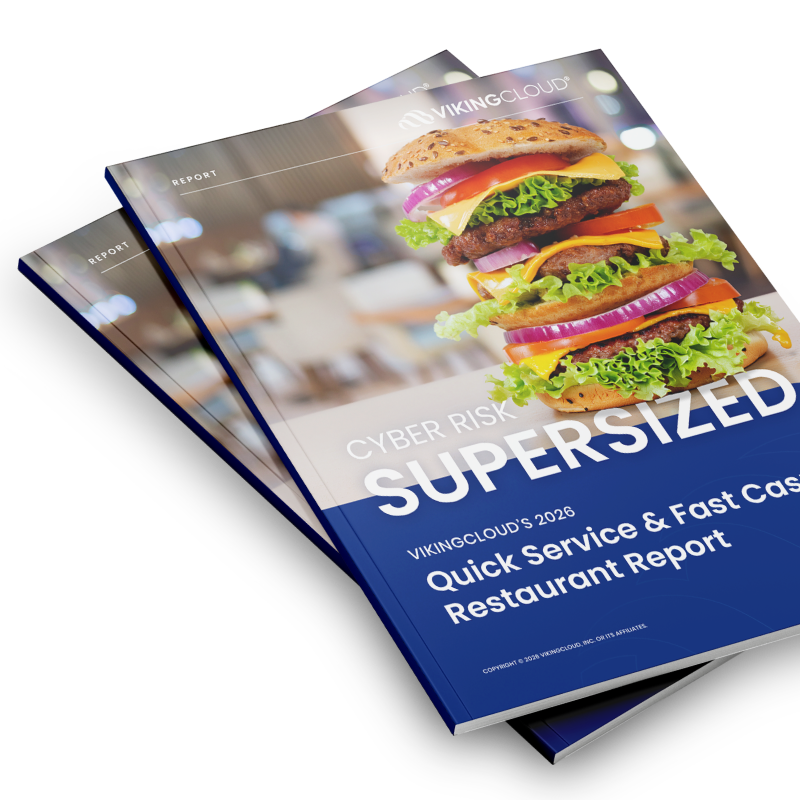
Ninety-four percent of IT leaders and franchise owners at quick-service restaurants (QSR) and fast-casual restaurants are confident in their ability to prevent or detect a cyberattack. Data from VikingCloud’s Cyber Risk, Supersized: 2026 Quick Service & Fast Casual Restaurant Report highlights that confidence doesn’t reflect reality: 80% experienced a cyber incident in the past 12 months—and many had confidential customer data leaked.
The reality gap lies in how organizations define preparedness. For most, that means successful PCI compliance assessments. In fact, 74% self-report as fully PCI compliant today. But compliance and security aren’t the same thing. In separate VikingCloud research, 67% of small and mid-size businesses (SMBs) agree or strongly agree with the statement, “the fact that I am PCI compliant means I am cybersecure. It doesn’t.
PCI compliance was built to certify that cardholder data was protected at a single point in time, not to keep pace with today’s fast-moving threat landscape. It has nothing to say about the payroll systems, loyalty accounts, or internal credentials now turning up in real-world breaches, and it doesn’t account for one critical element: human error. One decision by a distracted employee during a busy shift can quickly put an entire restaurant chain at risk.
76% of restaurants had sensitive data leaked in a cyberattack last year. Yet 94% are confident in their security.

Hackers exploit high-volume environments.
Cybercriminals know a cashier rushing to keep a line moving presents an opportunity. They also know a manager trying to keep a key ingredient stocked amid a shortage is more likely to overlook a red flag. They exploit urgency, familiarity, and impersonation, making scams look like routine business activity.
In the past 12 months, 80% of QSRs and fast-casual restaurants experienced social engineering attacks, including:
- Fraudulent refund requests: 36% received fake refund demands from cybercriminals posing as customers.
- Credential phishing: 36% had employees targeted by phishing emails or text messages designed to steal login credentials.
- Supplier impersonation: 30% received fake invoices or payment requests from criminals posing as trusted suppliers.
- Artificial Intelligence (AI)-generated deepfakes: 30% experienced AI-generated voice or video impersonating executives to request unauthorized financial transfers.
These attacks blend into everyday restaurant operations. PCI compliance alone cannot protect a front-line employee from an AI-generated phone call that sounds like a company executive requesting an immediate wire transfer, or a manager contacted during the dinner rush by someone claiming to be corporate IT support.
Restaurant leaders recognize their security limitations. Forty-four percent say that employees prioritizing speed and customer experience over security protocols increase their cyber risk. More than one-third (36%) also say they feel "not at all" or only "somewhat" prepared to respond to an AI-generated deepfake attack.
So why does cybersecurity confidence stay so high? No one thinks they’ll be the next target until it’s too late. And even those who have been targeted are overlooking the warning signs.
More than a third of cyber leaders (36%) wrote off system and downtime “anomalies” such as point-of-sale (POS) system reboots, menu changes, and order errors as “tech bugs” in the past year. Many were later suspected to be cyberattacks in disguise. There’s no telling how many other incidents went unrecognized.
Prove your security posture with data.
Restaurants need fewer assumptions about their security posture and more evidence to back their confidence. Here’s how to get there:
- Replace assumptions with visibility. Confirm every location has 24x7 monitoring, standardized security controls, and a tested incident response plan. Just 36% of leaders say this is in place at every location today. One weak franchise location is an open door into the entire enterprise.
- Go beyond PCI compliance. The Payment Card Industry Data Security Standard (PCI DSS) is designed to help merchants protect cardholder data, but it only certifies a security checklist. A point-in-time checklist says nothing about your real and changing exposure. Move past annualized audits to proactive threat detection and response, continuous vulnerability scanning, and network security solutions that mitigate phishing and ransomware risk.
- Validate your human defenses. Pair employee awareness training with penetration testing to identify vulnerabilities before attackers do. Simulated social engineering exercises help ensure human employees uphold security policies even on the busiest shift.
VikingCloud helps restaurant operators close the cybersecurity confidence gap through its AI-powered Asgard Platform®, delivering complete visibility across cybersecurity and compliance. From 24x7 monitoring and Managed Detection & Response to PCI compliance management, the Asgard Platform provides a secure, centralized hub that helps protect company-owned and franchised locations with a unified view of threats and vulnerabilities.
Read the full survey report for more on the restaurant industry’s cyber threats. Contact our team to learn how to mitigate each franchise location’s security vulnerabilities before they put the entire chain at risk.
76% of restaurants had sensitive data leaked in a cyberattack last year. Yet 94% are confident in their security.


Related Blogs
Stay up-to-date on the latest happenings in Cybersecurity and PCI Compliance.



.png)