
%20(1).png)
The most prominent cyber threat to SMEs is clickable attacks. But how do you defend your business against these attacks when you lack the resources of larger enterprise organizations? This infographic includes the 7 best solutions to mitigate your cyber risk and ensure you’re set up for success.
Cyberattacks on businesses have increased over the past 12 months1:

The risks that come with a modern SME.
Integrating multiple technologies for your business to be competitive
is how business gets done in today’s online environment.
.svg)
of small businesses have their own website.2

.svg)
of businesses use social media as their primary means to reach customers.3
.png)
The real danger is coming from inside.
Single-click attack methods are insidious and difficult to protect against, often appearing in seemingly harmless emails or links.

of companies reported being unprepared for phishing attacks, according to VikingCloud research.

of cyberattacks on SMEs
are the result of phishing emails.4
The threat landscape.
Single-click threats come disguised as something legitimate, such as emails, advertisements, and even links from within your company.

Emails or text messages to trick employees or customers into revealing sensitive information.

Software or code designed to disrupt, damage,
or access unauthorized data, often sent through email links or legitimate-looking websites.

Automated threats exploiting hardware or software vulnerabilities, redirecting users to malicious sites where the kit silently downloads and executes its payload.

The sneakiest and most dangerous, where a user unknowingly downloads malware from a seemingly legitimate site.
Here are 7 strategies to mitigate clickable risks to your business.
Conduct employee education
and awareness training.
A 2023 study conducted by IBM found
that human error is the cause of 95%
of cybersecurity incidents.5
Develop a training program to ensure
your team is prepared and ready to be
your first – and last line of cyber
defense.

Employ advanced filtering technologies.
Utilize simple-to-use, highly advanced security filtering solutions to block malicious emails, websites, and downloads before they reach your end users.
of accounts taken over begin with a single phishing email.7

Use endpoint protection
software.
Your enterprise’s best line of
defense is ensuring endpoint
protection software is installed
on every device in your
organization, be it smartphones,
tablets, or computers.


Complete regular assessments and penetration testing.
Security assessments and penetration testing are routine check-ups and stress tests for your business’s cybersecurity health that examine your systems and simulate attacks to reveal vulnerabilities.
Employ multi-factor
authentication (MFA).

Unique physical characteristics for
authentication—one of the most secure
MFA methods available.

In 2023, MFAs blocked 99.9% of modern
automated cyberattacks with a 96%
success rate of blocking bulk phishing
attempts.8
%201.png)
Implement an incident response plan (IRP).
An IRP is a comprehensive roadmap to follow in the event of a potential malicious event.
.png)
of small businesses have no security plan or protection against cyberattacks.9
Establish a cross-functional team.
Implement monitoring tools.
Immediately contain the threat.
Eliminate the threat from your system.
Bring your systems back online.
Conduct a post-incident review.
Continue to monitor and develop threat intelligence.
Adopting the right monitoring and intelligence tools allows your defensive strategies to adapt to evolving threats.

Track threats and vulnerabilities in real-time to help identify and address threats early. Start by deploying security tools like Managed Detection and Response, Next Generation AV (NGAV), and Windows Event Logging (WEL).

Analyze and utilize the data to identify relevant threats, assess their impact, and prioritize based on your organization’s specific risk profile.
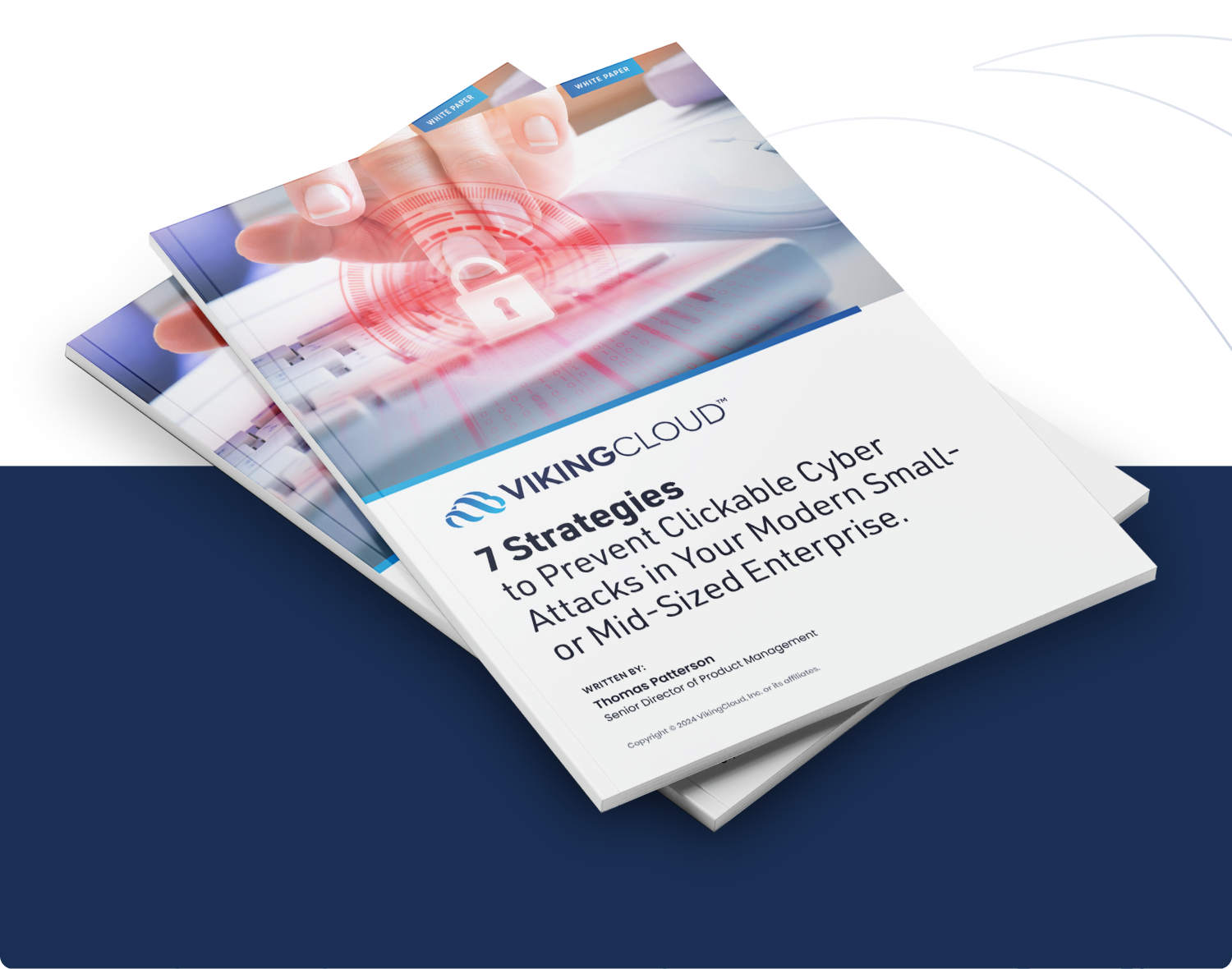
For the full report, download this white paper.
7 strategies to prevent clickable cyberattacks in your modern small or mid-sized enterprise.

.png)
Prevent clickable cyberattacks with VikingCloud
Our expert advisors and proven solutions are ready to help stop threats before they stop your business.

Copyright © 2026 VikingCloud, Inc. or its affiliates.


The most prominent cyber threat to SMEs is clickable attacks. But how do you defend your business against these attacks when you lack the resources of larger enterprise organizations? This infographic includes the 7 best solutions to mitigate your cyber risk and ensure you’re set up for success.
Cyberattacks on businesses have increased over the past 12 months1:
The risks that come with a modern SME.
Integrating multiple technologies for your business to be competitive
is how business gets done in today’s online environment.
of small businesses have their own website.2
of businesses use social media as their primary means to reach customers.3
The real danger is coming from inside.
Single-click attack methods are insidious and difficult to protect against, often appearing in seemingly harmless emails or links.
of companies reported being unprepared for phishing attacks, according to VikingCloud research.
of cyberattacks on SMEs
are the result of phishing emails.4
The threat landscape.
Single-click threats come disguised as something legitimate, such as emails, advertisements, and even links from within your company.
Emails or text messages to trick employees or customers into revealing sensitive information.
Software or code designed to disrupt, damage,
or access unauthorized data, often sent through email links or legitimate-looking websites.
Automated threats exploiting hardware or software vulnerabilities, redirecting users to malicious sites where the kit silently downloads and executes its payload.
The sneakiest and most dangerous, where a user unknowingly downloads malware from a seemingly legitimate site.
Here are 7 strategies to mitigate clickable risks to your business.
Conduct employee education
and awareness training.
A 2023 study conducted by IBM found
that human error is the cause of 95%
of cybersecurity incidents.5
Develop a training program to ensure
your team is prepared and ready to be
your first – and last line of cyber
defense.
Employ advanced filtering technologies.
Utilize simple-to-use, highly advanced security filtering solutions to block malicious emails, websites, and downloads before they reach your end users.
of accounts taken over begin with a single phishing email.7
Use endpoint protection
software.
Your enterprise’s best line of
defense is ensuring endpoint
protection software is installed
on every device in your
organization, be it smartphones,
tablets, or computers.
Complete regular assessments and penetration testing.
Security assessments and penetration testing are routine check-ups and stress tests for your business’s cybersecurity health that examine your systems and simulate attacks to reveal vulnerabilities.
Employ multi-factor
authentication (MFA).
Unique physical characteristics for
authentication—one of the most secure
MFA methods available.
In 2023, MFAs blocked 99.9% of modern
automated cyberattacks with a 96%
success rate of blocking bulk phishing
attempts.8
Implement an incident response plan (IRP).
An IRP is a comprehensive roadmap to follow in the event of a potential malicious event.
of small businesses have no security plan or protection against cyberattacks.9
Establish a cross-functional team.
Implement monitoring tools.
Immediately contain the threat.
Eliminate the threat from your system.
Bring your systems back online.
Conduct a post-incident review.
Continue to monitor and develop threat intelligence.
Adopting the right monitoring and intelligence tools allows your defensive strategies to adapt to evolving threats.
Track threats and vulnerabilities in real-time to help identify and address threats early. Start by deploying security tools like Managed Detection and Response, Next Generation AV (NGAV), and Windows Event Logging (WEL).
Analyze and utilize the data to identify relevant threats, assess their impact, and prioritize based on your organization’s specific risk profile.
For the full report, download this white paper.
7 strategies to prevent clickable cyberattacks in your modern small or mid-sized enterprise.
Prevent clickable cyberattacks with VikingCloud
Our expert advisors and proven solutions are ready to help stop threats before they stop your business.
Copyright © 2026 VikingCloud, Inc. or its affiliates.
Fill out the form and click submit to access the file.
It is our business to keep current and prospective customers informed about the products, services and thought leadership topics that may be relevant to the success of their cybersecurity and compliance programs. By completing this form, you are agreeing to our sending you occasional related business insights. You can unsubscribe at any time. For details, view our Privacy Policy.
.png)